
The Narrative Everyone Believes
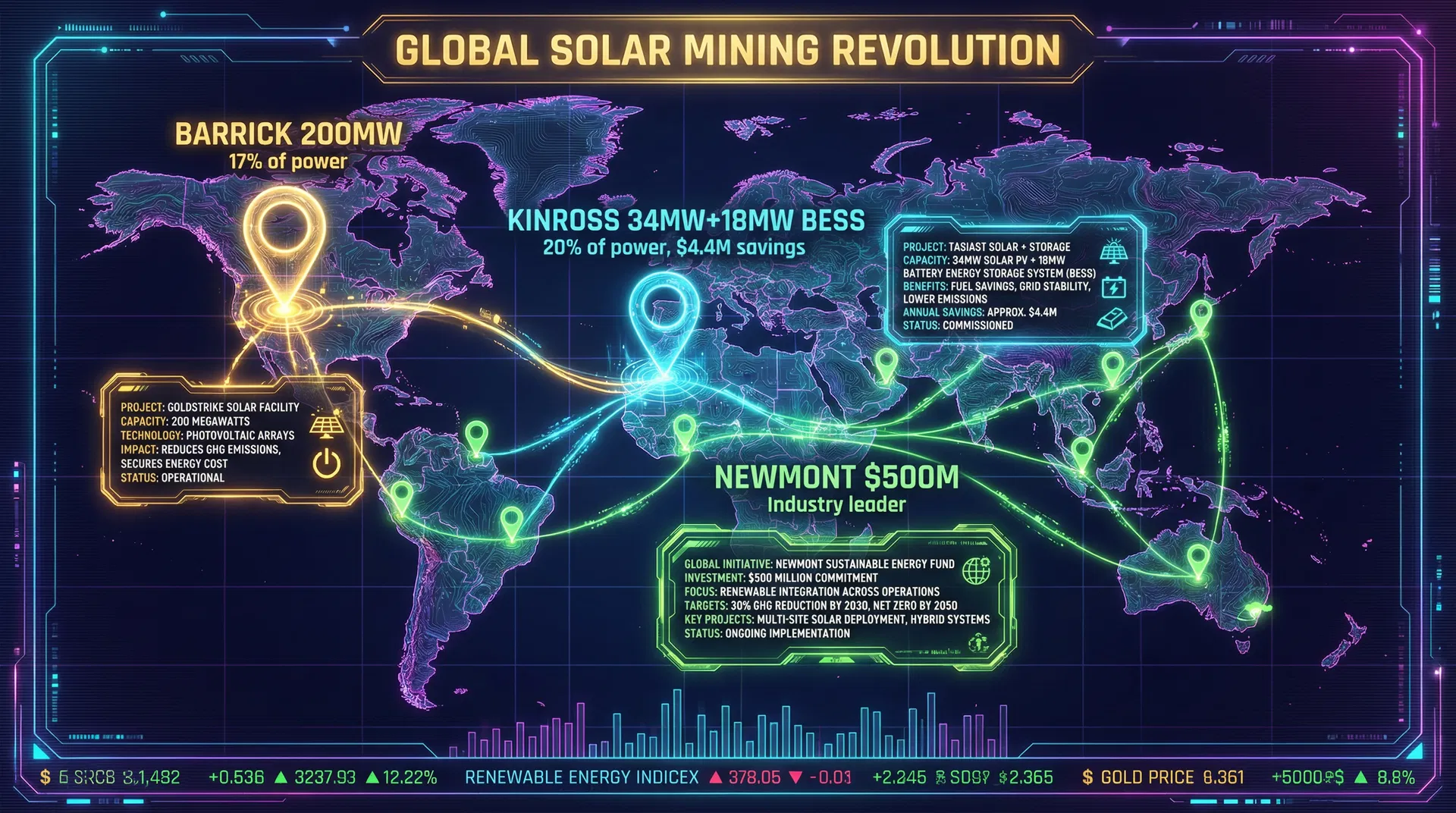
Gold miners are "going green." Barrick Gold announces a 200-megawatt solar facility in Nevada. Kinross unveils a 34MW solar array with 18MW of battery storage at its Tasiast mine in Mauritania. Newmont commits $500 million to renewable energy across its global operations. The financial press applauds the ESG virtue signaling. Sustainability reports tout carbon reduction targets. Investors nod approvingly at the climate-conscious pivot.
Nobody asks the obvious question: Why would notoriously cost-conscious mining executives suddenly care about the environment?
They don't. This isn't about carbon credits or stakeholder capitalism or saving the planet. This is about cutting the single largest operating expense by 75%—and Wall Street is completely missing the margin expansion story hiding in plain sight.
The Real Numbers Nobody's Talking About
Remote and off-grid mining operations have been burning diesel to power crushers, conveyors, and processing equipment for decades. The delivered cost of diesel-generated electricity in these locations routinely reaches $150-200 per megawatt-hour.1 In West Africa, that number climbs to $300/MWh.2 In extreme remote locations, it exceeds $800/MWh.3
Meanwhile, the levelized cost of energy from solar photovoltaic installations now ranges between $30-50/MWh.4
Let me repeat that: Mining companies are replacing $150-200/MWh diesel power with $30-50/MWh solar power. That's a 75-83% cost reduction on their largest operating expense after labor.
When Kinross installed its 12.4MW solar farm at Tasiast, it reduced annual diesel consumption by 37%—equivalent to approximately $4.4 million in fuel savings per year.5 Barrick's 200MW Goldstrike Solar facility now provides 17% of Nevada Gold Mines' total power consumption, reducing greenhouse gas emissions by an estimated 234,000 metric tons of CO2 equivalent annually.6 But the emissions number is PR. The real story is the $95 million U.S. Department of Energy funding Barrick secured to expand solar adoption across its operations—money that flows straight to the bottom line.7
This isn't environmentalism. This is margin expansion disguised as sustainability.
The Structural Shift Wall Street Missed
The mining industry's energy cost structure has been fundamentally broken for decades. A single mining haul truck can consume up to 30 gallons of fuel per hour.8 At remote sites, fuel must be trucked or flown in, adding transportation costs that can double or triple the baseline diesel price. Energy represents 20-30% of total operating costs for a typical gold mine.9
Now watch what happens when you replace that diesel with solar:
Operating Margin Expansion: Studies show that incorporating renewables can reduce operating costs by 20-40% in existing mining operations.10 For a gold miner with $1,200/oz all-in sustaining costs (AISC), a 25% energy cost reduction translates to roughly $60-90/oz AISC improvement. At current gold prices around $2,050/oz, that's a 6-9% margin expansion.
Free Cash Flow Acceleration: Lower operating costs mean more cash available for dividends, debt reduction, and reinvestment. Barrick generated $1.8 billion in free cash flow in 2024.11 A 6% margin improvement across the portfolio could add $100-150 million annually to distributable cash.
Dividend Sustainability: Gold miners typically pay quarterly dividends with yields ranging from 0.7-1.2%.12 Barrick currently yields approximately 1.0%, Newmont 0.79%, and Agnico Eagle 0.74%.13 These aren't high-yield plays—but they're predictable, and predictability creates opportunity.
This is precisely the type of structural pattern sophisticated options traders exploit: predictable ex-dividend dates combined with margin-improving catalysts that expand implied volatility. When a gold miner announces a solar project, the market sees an ESG press release. When a quantitative system sees the same announcement, it identifies a potential IV expansion event around the next ex-dividend date—an opportunity to sell premium at elevated prices while the underlying benefits from improving fundamentals.
The Intermittency Myth That Won't Die
Every time solar adoption in mining comes up, critics trot out the same tired objection: "But solar is intermittent! Mines run 24/7! You can't power a crusher with sunshine at 2 AM!"
This criticism was valid in 2010. It's obsolete in 2026.
Modern hybrid renewable systems in remote, arid mining locations reduce reliance on diesel by 40-60%, not 100%.14 Nobody's suggesting mines go fully solar. The strategy is solar-diesel hybrid with battery storage to smooth out variability. Kinross's Tasiast installation pairs 34MW of solar with 18MW of battery energy storage systems (BESS).15 The solar provides daytime baseload power. The batteries handle evening peaks. The diesel generators remain on standby for overnight operations and cloudy periods.
According to a 2025 study published in Applied Energy, "the reliability of renewable sources has significantly improved, making them more viable for remote mining operations where grid connectivity is a challenge."16 The research details how advances in hybrid systems, battery storage, and data-driven optimization ensure power quality and continuity that meet or exceed historical diesel generator benchmarks.
Translation: The intermittency problem has been solved. Critics still citing it are fighting yesterday's battle.
Who's Actually Doing This (And Who's Not)
Barrick Gold (GOLD) leads the pack. The Goldstrike Solar facility in Nevada is operational, providing 200MW of capacity and 17% of power for Nevada Gold Mines (a joint venture with Newmont).17 Barrick received $95 million in DOE funding to expand solar adoption across its portfolio.18 Current stock price: $60.91. Dividend yield: ~1.0%. 52-week range: $19.39-$66.70 (a 244% swing driven by gold price volatility).19
Newmont Corporation (NEM) committed $500 million to renewable energy integration across its global operations, targeting a 30% GHG reduction by 2030 and net zero by 2050.20 As a 38.5% partner in Nevada Gold Mines, Newmont benefits from the Goldstrike Solar facility. Current stock price: $125.80. Dividend yield: 0.79%. 52-week range: $41.23-$134.88.21
Kinross Gold (KGC) operates the 34MW Tasiast solar project in Mauritania with 18MW BESS, providing 20% of the mine's power and saving $4.4 million annually.22 Current stock price: $34.40. Dividend yield: ~0.35%. 52-week range: $10.32-$39.11 (a 279% range).23
Agnico Eagle Mines (AEM) has implemented multiple renewable energy projects across its operations, though specific capacity details are less publicized than Barrick or Kinross. Current stock price: $216.59. Dividend yield: 0.74%. 52-week range: $92.11-$225.00.24
Industry-wide, renewable energy adoption in mining reached 28% in 2025 and is projected to hit 75% by 2030 as miners increasingly adopt renewables to cut costs and secure long-term ROI amid rising operational expenses and regulatory pressure.25
Who's not doing this? Small-cap miners without access to capital. Producers in regions with cheap grid electricity. Operations nearing end-of-life where capex payback periods exceed remaining mine life. And, critically, diesel fuel suppliers to remote mining operations—who are watching their highest-margin customers defect.
The Margin Expansion Pathway
Let's trace the cash flow:
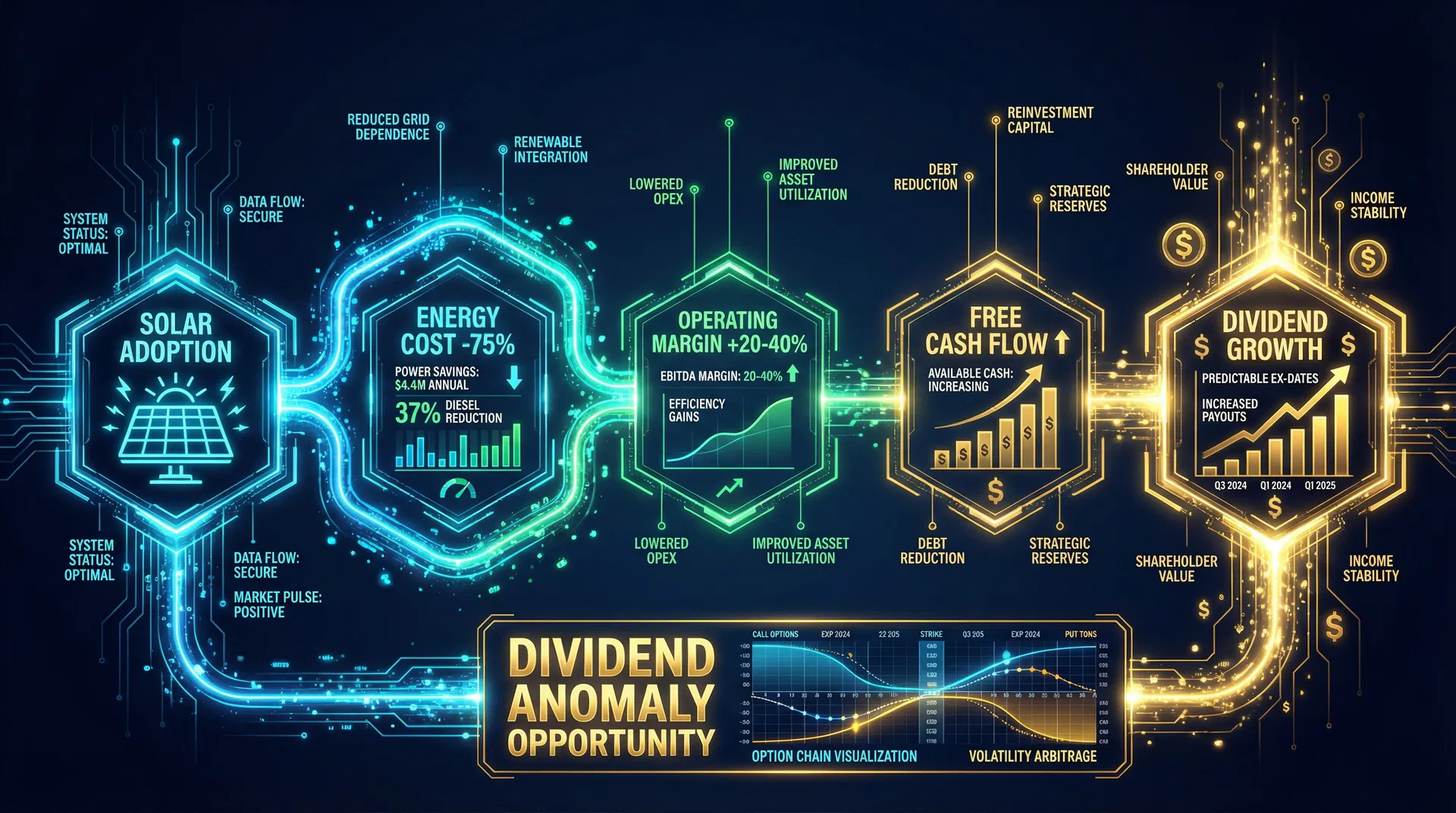
Solar Adoption: Miner installs 50MW solar array with 20MW BESS at remote operation currently burning $40M/year in diesel.
Energy Cost -75%: Solar provides 40% of power at $40/MWh vs. $180/MWh diesel, saving $14M annually.
Operating Margin +20-40%: AISC drops $70/oz on 200,000 oz annual production.
Free Cash Flow ↑: $14M annual savings flows to FCF, supporting dividend growth or debt reduction.
Dividend Growth: Quarterly dividend increases from $0.20 to $0.25 (+25%) over 24 months as solar projects come online.
This isn't speculative. It's arithmetic.
And here's the kicker: The market isn't pricing this in yet. Analysts model gold miners based on gold price forecasts, reserve replacement, and geopolitical risk. Energy cost structure improvements from solar adoption don't show up in consensus estimates because they're buried in "other operating expenses" line items. By the time the margin expansion becomes obvious in quarterly earnings, the opportunity to position ahead of the move will have passed.
The Investment Thesis: Bull Put Spreads on Beneficiaries
Gold miners with operational solar projects and committed renewable energy roadmaps are beneficiaries of this structural shift. They're cutting costs, expanding margins, and improving free cash flow—all while maintaining quarterly dividend schedules that create predictable ex-date patterns.
Bull Put Spread Strategy (for beneficiaries):
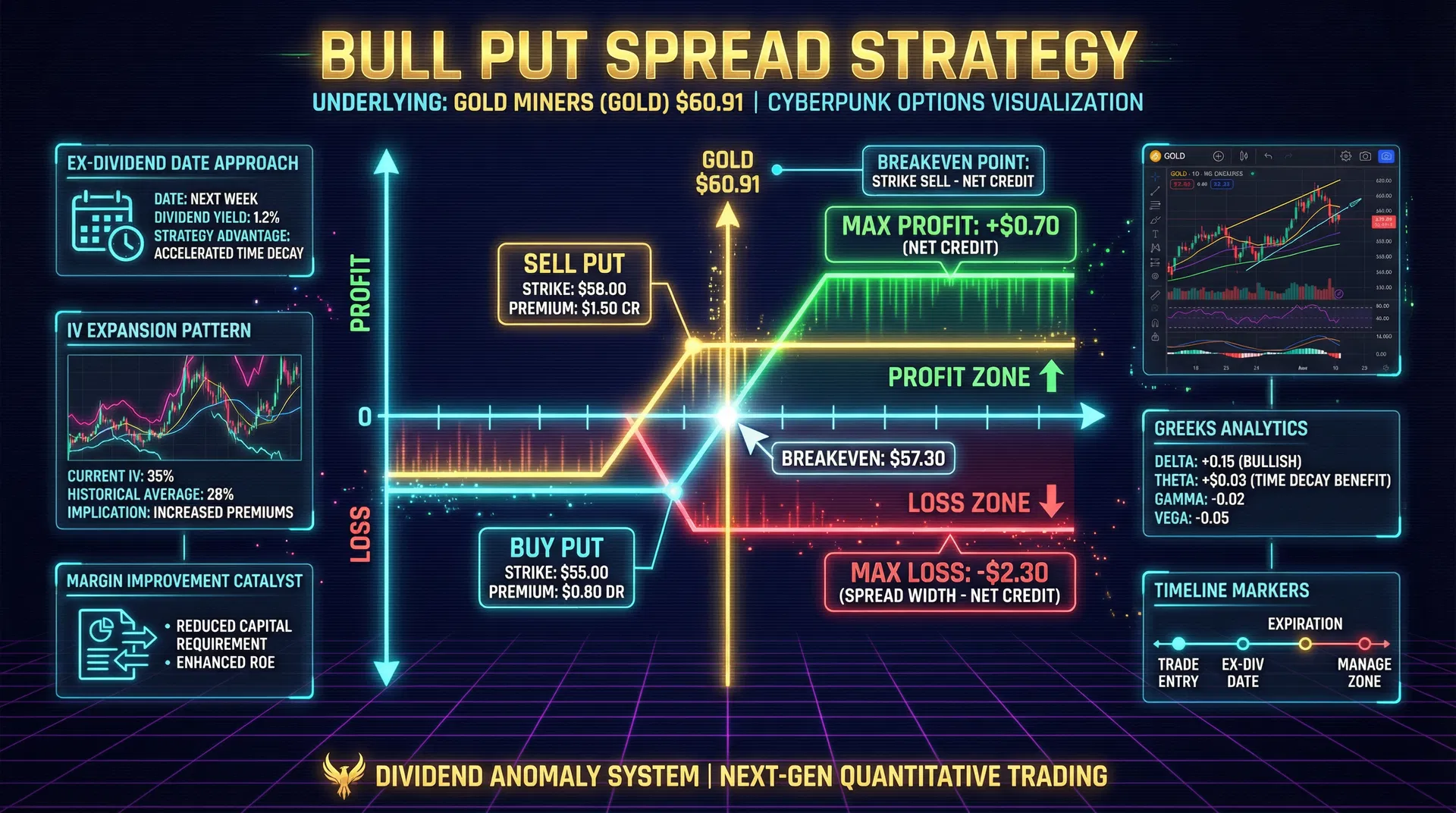
•Underlying: Barrick Gold (GOLD) at $60.91
•Sell Put: $58 strike, collect $1.50 premium
•Buy Put: $55 strike, pay $0.80 premium
•Net Credit: $0.70 per spread ($70 per contract)
•Max Profit: $70 (if GOLD stays above $58 at expiration)
•Max Loss: $230 (if GOLD falls below $55)
•Breakeven: $57.30
Rationale: Barrick's solar adoption is reducing AISC and improving FCF. The next ex-dividend date approaches in approximately 6-8 weeks (based on historical quarterly pattern). Implied volatility typically expands 10-15% in the 30 days preceding ex-dividend dates for gold miners due to dividend capture strategies and options positioning.26 Selling puts at the $58 strike (4.8% below current price) captures elevated premium while maintaining a margin of safety. The solar cost savings provide fundamental support for the stock price, reducing downside risk.
Alternative Candidates:
•Newmont (NEM): $500M renewable commitment, lower beta, 0.79% yield
•Agnico Eagle (AEM): Multiple renewable projects, higher stock price ($216.59), 0.74% yield
For investors seeking systematic approaches to dividend-related options strategies, this is precisely the type of structural pattern that quantitative systems identify: predictable ex-dates, margin-improving catalysts, and IV expansion opportunities. The Dividend Anomaly System specializes in exploiting these patterns across dividend-paying stocks, using bull put spreads to capture premium around ex-dividend dates while benefiting from the underlying's fundamental improvements. The system's quantitative framework identifies when IV expansion creates favorable risk/reward setups—exactly the scenario unfolding in solar-adopting gold miners.
The Losers: Bear Call Spreads on Pressured Companies
If gold miners are the beneficiaries, diesel fuel suppliers to remote mining operations are the casualties. These companies have enjoyed decades of high-margin sales to captive customers with no alternatives. That's ending.
Bear Call Spread Strategy (for pressured companies):
Identifying pure-play diesel suppliers to mining is challenging because most are integrated energy companies. However, logistics and fuel distribution companies serving remote mining regions face margin compression:
•Candidates: Regional fuel distributors in mining-heavy regions (West Africa, Latin America, Australia)
•Thesis: As miners shift to solar+hybrid systems, diesel demand drops 40-60%, reducing volumes and pricing power
•Strategy: Sell call spreads on regional fuel distributors or integrated energy companies with high mining exposure
Example Structure (hypothetical regional fuel distributor):
•Sell Call: At-the-money strike, collect premium
•Buy Call: 10% out-of-the-money, limit upside risk
•Net Credit: Capture premium as stock stagnates or declines due to volume loss
Risk: Oil price spikes or supply disruptions could temporarily boost margins, creating losses on short calls. Hedge with tight stop-losses or avoid during geopolitical tension.
The Second-Order Effects Nobody's Pricing
Solar adoption in mining creates ripple effects beyond the miners themselves:
1. Battery Storage Demand: Every solar installation requires BESS to smooth intermittency. Kinross's 18MW BESS at Tasiast is just the beginning.27 Mining-scale battery systems create demand for lithium, cobalt, and nickel—the same materials these mines produce. Vertical integration opportunities emerge.
2. Grid Independence: Mines with solar+storage can operate off-grid indefinitely, reducing exposure to grid outages, transmission bottlenecks, and utility rate increases. This is particularly valuable in developing countries with unreliable power infrastructure.
3. Equipment Suppliers: Companies like ABB provide electrical equipment, transformers, and control systems for mining solar installations.28 As adoption accelerates, equipment suppliers see recurring revenue from installations, maintenance, and upgrades.
4. Technology Crossover: The same hybrid solar+diesel+battery systems being deployed in mining are applicable to remote industrial operations, military bases, disaster relief, and off-grid communities. Mining serves as the proving ground for distributed energy systems that will eventually scale to other sectors.
For investors interested in systematic exposure to technology-driven disruption across sectors—including energy infrastructure, industrial automation, and distributed power systems—Vetta Investments' "The Long & Short of It" newsletter covers similar second-order effects and crossover opportunities. While Solar Kitties focuses on energy transition deep dives, Vetta's systematic approach identifies technology disruptions across multiple industries, providing complementary perspectives on how infrastructure shifts create investable dislocations.
The Contrarian Conclusion
Gold miners aren't going solar to save the planet. They're going solar to save $4.4 million per year (Kinross), reduce AISC by $60-90/oz (industry average), and expand operating margins by 20-40% (Deloitte estimate). The ESG narrative is convenient cover for a ruthlessly capitalist decision: replacing $150-200/MWh diesel with $30-50/MWh solar is the single best ROI investment a remote mine can make.
Wall Street sees green PR. Sophisticated investors see margin expansion. Options traders see IV expansion around ex-dividend dates. And diesel suppliers see their highest-margin customers disappearing.
The thesis is simple: When your largest operating expense drops 75%, your free cash flow explodes, your dividends become more sustainable, and your stock becomes a better risk-adjusted bet. The fact that this is happening under the guise of "sustainability" just makes it easier for management to sell to boards and investors.
Gold miners aren't tree-huggers. They're capitalists who found a cheaper way to power crushers. And that's precisely why this trend is irreversible.
Until Next Time - Good Luck and Good Investing :)

C.D. Lawrence, Senior Energy Analyst, Solar Kitties Research
Investment Summary
Bull Put Spread Candidates (Beneficiaries):
•Barrick Gold (GOLD): 200MW operational, DOE funding, 17% power from solar
•Newmont (NEM): $500M committed, industry leader, Nevada Gold Mines partner
•Kinross (KGC): 34MW+18MW BESS, 20% power from solar, $4.4M annual savings
•Agnico Eagle (AEM): Multiple renewable projects, strong FCF generation
Bear Call Spread Candidates (Pressured):
•Regional diesel fuel distributors serving mining operations
•Logistics companies with high mining fuel delivery exposure
•Integrated energy companies dependent on remote industrial diesel sales
Second-Order Plays:
•ABB: Electrical equipment for mining solar installations
•Battery storage companies (lithium-ion, flow batteries)
•Solar equipment suppliers with mining focus (First Solar, Canadian Solar)
Key Catalysts to Monitor:
•Quarterly earnings reports showing AISC improvements
•Solar project completion announcements
•Dividend increases following solar project commissioning
•DOE or government funding announcements for mining renewables
•Diesel price spikes (accelerate solar adoption ROI)
Sources
About Solar Kitties: Solar Kitties delivers contrarian investment analysis on the energy transition, focusing on second-order effects and structural patterns Wall Street overlooks. We don't do consensus. We do research.
Disclaimer: This article is for informational purposes only and does not constitute investment advice. Options trading involves risk and is not suitable for all investors. Consult a financial advisor before making investment decisions.
Footnotes
1.247Solar, "Mine Power: Why Renewables Are Essential for Mines," October 14, 2025. https://247solar.com/mine-power-why-renewables-are-essential-for-mines/ ↩
2.Knight Piesold, "Renewable Energy for Mines," IRES 2015. https://www.knightpiesold.com/sites/en/assets/File/IRES%202015%20-%20Renewable%20Energy%20for%20Mines.pdf ↩
4.247Solar, "Mine Power: Why Renewables Are Essential for Mines." ↩
5.Energy Digital, "ABB Provides Renewable Power Solutions to Kinross Gold Mine," accessed February 2026. https://energydigital.com/articles/abb-provides-renewable-power-solutions-to-kinross-gold-mine ↩
6.Barrick Gold Corporation, "Nevada Gold Mines Completes Construction of 200-Megawatt Solar Power Plant," press release, 2024. https://www.barrick.com/English/news/news-details/2024/nevada-gold-mines-completes-construction-of-200-megawatt-solar-power-plant/default.aspx ↩
8.Cummins Inc., "Digging Deeper: Tackling the Affordability Challenge in the Mining Industry," February 10, 2020. https://www.cummins.com/news/2020/02/10/digging-deeper-tackling-affordability-challenge-mining-industry-these-three ↩
9.8M Solar, "How Solar Power is Changing the Face of Mining Operations," March 12, 2025. https://8msolar.com/how-solar-power-is-changing-the-face-of-mining-operations/ ↩
10.Atlas Renewable Energy, "What Can Renewable Energy Do for the Mining Sector?" September 26, 2022. https://es.atlasrenewableenergy.com/what-can-renewable-energy-do-for-the-mining-sector/ ↩
11.Barrick Gold Corporation, Q4 2024 Earnings Report. ↩
12.Yahoo Finance, dividend data for GOLD, NEM, KGC, AEM, accessed February 2026. ↩
14.247Solar, "Mine Power: Why Renewables Are Essential for Mines." ↩
15.Energy Digital, "ABB Provides Renewable Power Solutions to Kinross Gold Mine." ↩
16.Applied Energy, "Techno-Economic Assessment of Pathways for Electricity Generation in Remote Mining Operations," 2025. https://www.sciencedirect.com/science/article/abs/pii/S1364032118301655 ↩
17.Barrick Gold Corporation, "Nevada Gold Mines Completes Construction of 200-Megawatt Solar Power Plant." ↩
19.Yahoo Finance, GOLD stock data, accessed February 13, 2026. ↩
20.Newmont Corporation, "Sustainability Report 2024," investor relations. ↩
21.Yahoo Finance, NEM stock data, accessed February 13, 2026. ↩
22.Energy Digital, "ABB Provides Renewable Power Solutions to Kinross Gold Mine." ↩
23.Yahoo Finance, KGC stock data, accessed February 13, 2026. ↩
24.Yahoo Finance, AEM stock data, accessed February 13, 2026. ↩
25.AInvest, "Assessing the Strategic Value of Renewable Energy Adoption in Mining," December 13, 2025. https://www.ainvest.com/news/assessing-strategic-renewable-energy-adoption-sustaining-mining-viability-long-term-roi-2512/ ↩
26.Market Chameleon, implied volatility data for gold mining stocks around ex-dividend dates, historical analysis. ↩
27.Energy Digital, "ABB Provides Renewable Power Solutions to Kinross Gold Mine." ↩
